






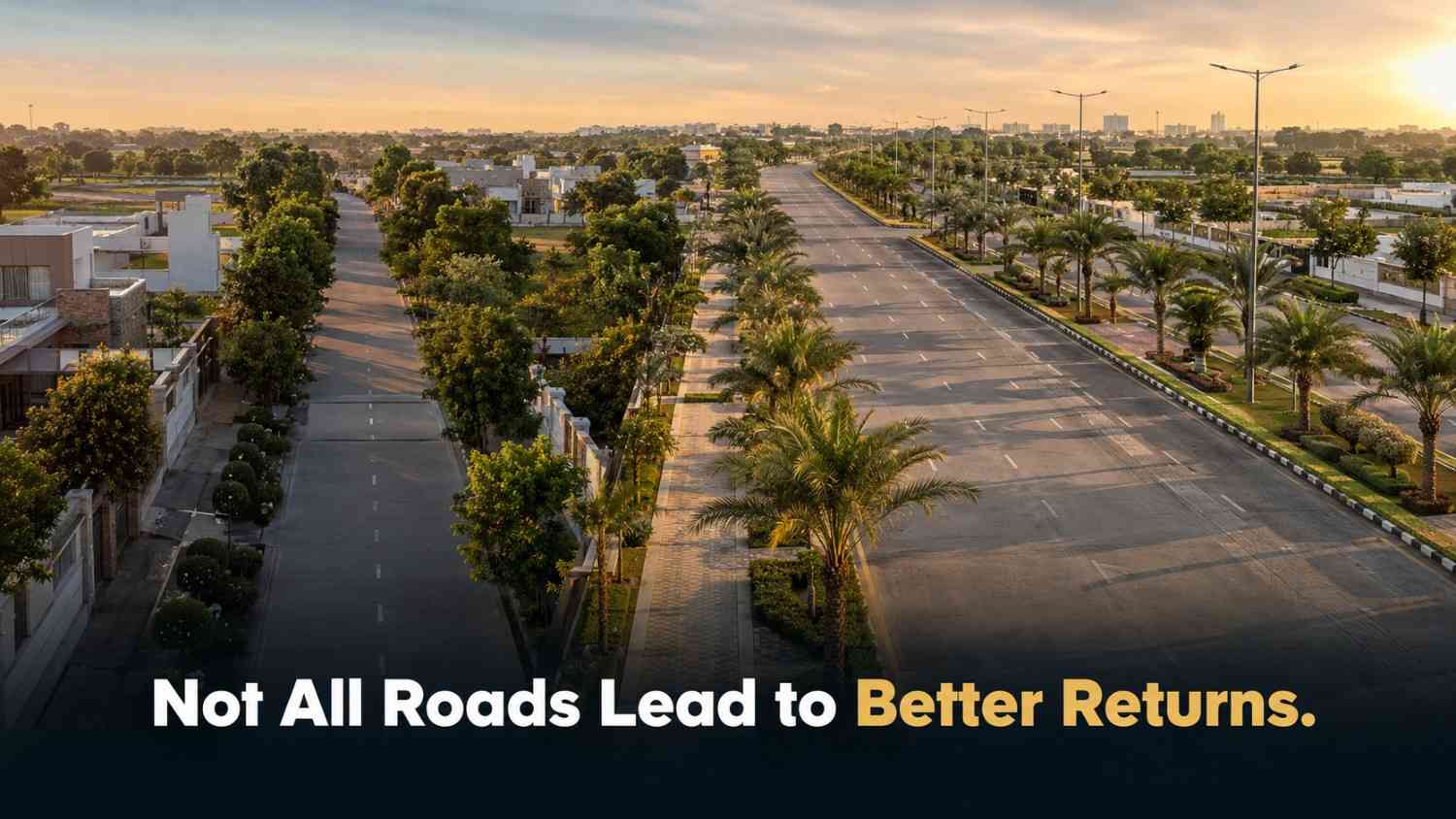
Walk into any plotting layout in Nagpur today, and you will hear the same question from almost every buyer: Road Width for Residential plot “Kitni width ka road hai?” It has become the single most repeated line during a site visit, right after “rate kya hai?”
There is a reason for this. Over the years, brokers, YouTube videos, and word-of-mouth advice have created one simple belief in the minds of buyers: wider road means better plot, and better plot means better returns. On the surface, this sounds logical. A wide road looks impressive. It photographs well. It feels “developed.”
But here is what fifteen years of studying Nagpur’s plotted layouts, Development Plans, and resale patterns has taught us: road width, by itself, tells you almost nothing about whether a plot is a good buy.
A 30 ft road in a well-planned residential pocket, close to schools and with clear title documents, can outperform an 80 ft road that turns out to be an unapproved paper road with no real construction activity around it for the next decade. Similarly, an 80 ft Development Plan (DP) road with strong commercial potential can be an outstanding investment — but only if the layout is legally sanctioned and the road alignment is not going to eat into your plot boundary later.
Experienced investors rarely ask “how wide is the road?” as their first question. Instead, they ask a more useful one: “Where does this road sit in the town’s road hierarchy, and what is it designed to serve?”
This single shift in thinking — from “wide is good” to “purposeful is good” — is what separates a smart real estate decision from an emotional one. This guide will walk you through exactly how road width works in Indian town planning, what a 30 ft road is meant for, what an 80 ft road is meant for, how Development Plan alignments and road reservations can affect your plot, what UDCPR means for layout approvals, and a complete checklist you can use before you sign anything.
This article is written for first-time buyers, families looking for a peaceful place to build a home, NRIs investing from abroad, and serious investors who want to understand the mechanics behind plot pricing — not just the marketing behind it.
Table of Contents
Understanding Road Width for Residential plot: The Basics of Town Planning
Before comparing 30 ft and 80 ft roads, it helps to understand why roads of different widths exist in the first place. No town planner sits down and draws roads randomly. Every road in a sanctioned layout or a city’s Development Plan is assigned a width based on the function it is expected to perform, both today and 20–30 years into the future.
In Indian urban planning, and specifically under frameworks like the UDCPR (Unified Development Control and Promotion Regulations) followed across Maharashtra, road widths are broadly linked to a hierarchy:
- Internal or access roads (typically 9–30 ft): Meant purely for reaching individual plots or homes within a layout. Low traffic, low speed, primarily residential movement.
- Layout/collector roads (30–40 ft): Connect internal roads to the main road network. Carry slightly more traffic but are still largely residential in character.
- Sub-arterial roads (40–60 ft): Carry traffic between different neighbourhoods and localities. Often see early commercial activity — shops, clinics, small offices.
- Arterial/DP roads (60–80 ft and above): Designed to carry heavy, fast-moving traffic across large parts of the city. These roads are the backbone of a city’s transport network and are where you typically see showrooms, malls, offices, and high-visibility commercial development.
This hierarchy is not arbitrary. It exists because a city cannot function if every road is designed the same way. If every internal residential lane were 80 ft wide, movement of heavy traffic would cut straight through quiet neighbourhoods. If every arterial road were only 30 ft wide, the city would face permanent traffic congestion as it grows.
How Road Width Connects to Future Development
The width of the road a plot sits on is often a strong signal (though not a guarantee) of what kind of development is expected to happen around it in the future.
- Connectivity: Wider roads generally connect a locality to the larger city grid, highways, or bypasses, which shortens travel time to important destinations.
- Traffic Flow: Higher width usually means the road is designed to carry more vehicles, at higher speed, for longer distances.
- Lifestyle: Narrower, low-traffic roads tend to support quieter, more family-friendly living environments.
- Commercial Activity: Businesses prefer high-visibility, high-footfall, easily accessible locations — which naturally pulls commercial interest toward wider roads.
- Future Expansion: Government infrastructure such as water pipelines, sewage trunks, and public transport routes are often planned along wider roads because there is physical space to accommodate them.
- Government Planning: Municipal and regional planning authorities (like NMRDA in Nagpur’s case) use road width classifications to decide zoning — where residential, commercial, and mixed-use development will be permitted.
Understanding this hierarchy is the real foundation for evaluating any plot — far more useful than simply comparing numbers like “30 ft” versus “80 ft” in isolation.

30 Ft Road: Purpose, Advantages, and Who It Suits Best
Purpose
A 30 ft road is typically an internal or layout access road. Its primary job is to connect individual plots or homes to the main road network of the locality — not to carry city-wide or highway-level traffic. In most sanctioned residential layouts across Nagpur, internal roads of 30–40 ft are extremely common and are considered completely normal and adequate for residential use.
Advantages of a 30 Ft Road Plot
- Quieter, low-traffic environment: Since these roads are not designed for heavy or through-traffic, noise and vehicle movement remain limited to residents and visitors.
- Safer for families and children: Lower vehicle speed and lower traffic volume make internal roads naturally safer for children playing outside or walking to school bus stops.
- Lower dust and pollution exposure: Less traffic generally means better air quality at the doorstep compared to a busy arterial stretch.
- Stronger sense of community: Residential pockets built around internal roads tend to develop a more close-knit, neighbourhood feel over time.
- Often more affordable per sq. ft.: Because these roads don’t carry commercial premium, plots here are usually priced more accessibly than main-road frontage.
Disadvantages of a 30 Ft Road Plot
- Limited commercial value: These plots are not ideal if your long-term goal is to open a shop, showroom, or commercial establishment.
- Slower resale appreciation in some cases: If the surrounding area does not develop as planned, appreciation may be slower compared to a well-connected arterial-facing plot.
- Dependent on layout quality: A 30 ft road inside a poorly planned or unapproved layout offers none of these benefits — the internal road width alone does not guarantee legality or infrastructure quality.
Best Suited For
A 30 ft road plot is generally the right choice for:
- Families who want a peaceful residential environment to raise children
- First-time home builders who prioritise safety and quiet living over visibility
- Buyers looking for a long-term family home, not a commercial asset
- Anyone who values lower noise, lower traffic, and a stronger community feel
60–80 Ft Road: Purpose, Advantages, and Who It Suits Best
Purpose
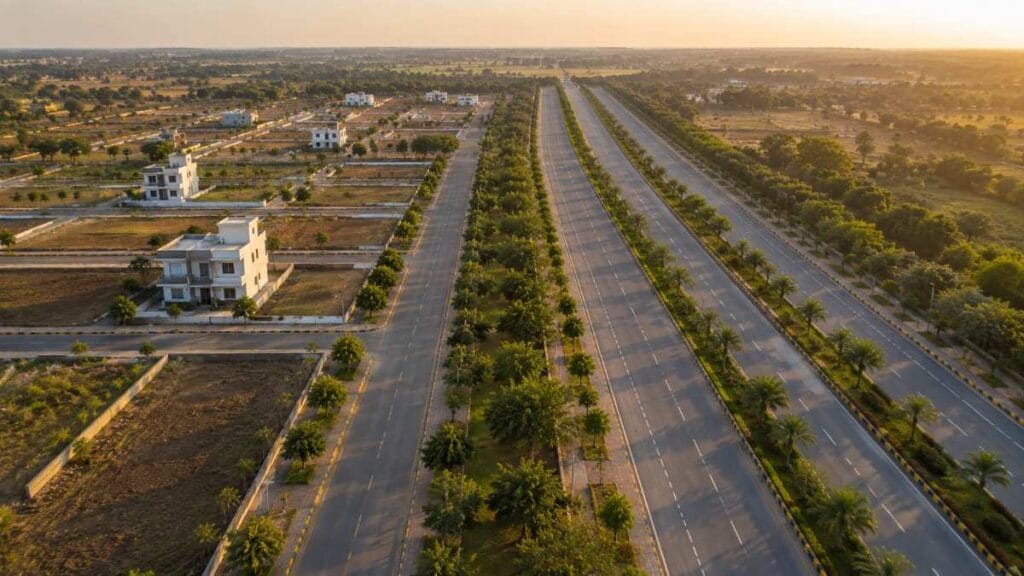
Roads in the 60–80 ft range typically function as sub-arterial or arterial roads. Their job is to move larger volumes of traffic across greater distances, connecting multiple localities, highways, and key city zones. These are the roads that show up prominently in a city’s Development Plan (DP) because they carry the weight of the city’s long-term transport strategy.
Advantages of a 60–80 Ft Road Plot
- Superior connectivity: These roads typically link directly to highways, bypasses, or major city arteries, cutting down travel time significantly.
- High visibility: For anyone planning future commercial use, frontage on a wide, well-travelled road offers far greater footfall and exposure.
- Strong commercial potential: Showrooms, offices, restaurants, and retail establishments naturally gravitate toward high-width, high-traffic roads.
- Faster infrastructure development: Because arterial roads are prioritised by planning authorities, areas around them often receive water supply, drainage, streetlights, and public transport connectivity sooner.
- Higher long-term appreciation potential — when the area develops as planned: As commercial and mixed-use activity increases, land values along these corridors can rise faster than purely residential internal roads.
Disadvantages of a 60–80 Ft Road Plot
- Higher traffic and noise: Constant vehicle movement, especially during peak hours, can make daily life noisier and less private.
- Less suited for quiet family living: The same visibility that benefits business is often a drawback for a peaceful residential lifestyle.
- Premium pricing: Wide-road frontage typically commands a price premium, which may not always be justified if commercial development is still years away.
- Longer gestation for returns: If the surrounding zone is still under-developed, the “commercial potential” of an 80 ft road may take many years to actually materialise.
Best Suited For
A 60–80 ft road plot generally works best for:
- Investors targeting commercial or mixed-use appreciation over the medium-to-long term
- Business owners planning showrooms, offices, or retail outlets
- Buyers prioritising connectivity and travel convenience over quiet surroundings
- Those comfortable trading some peace and privacy for visibility and growth potential
The Most Important Section: Approval & Alignment Clarity
This is the part most buyers skip — and it is often the most important part of the entire decision.
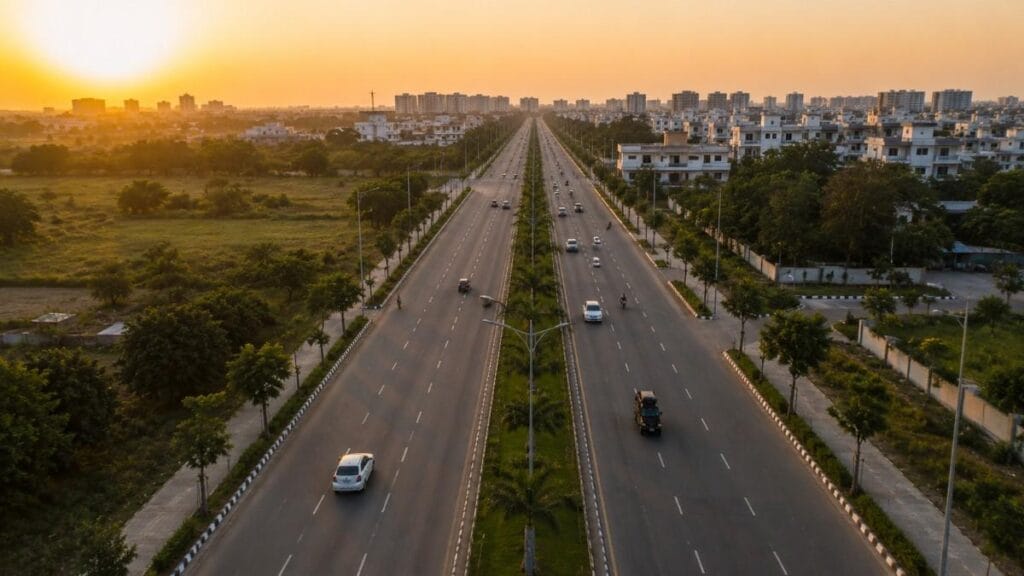
Why You Should Never Judge a Plot by Road Width Alone
A road number on a brochure — “30 ft road” or “80 ft DP road” — tells you the intended width. It does not tell you:
- Whether that road is actually constructed at that width today, or only planned for the future
- Whether the layout itself is sanctioned by the competent planning authority
- Whether your plot’s boundary is safe from a future road-widening alignment
- Whether any part of the land has been reserved for public use, such as a garden, school site, or utility
Development Plan (DP) Roads and Alignment
Every growing city, including Nagpur, has a Development Plan prepared by the relevant planning authority — in Nagpur’s case, this involves bodies such as the Nagpur Municipal Corporation (NMC) and the Nagpur Metropolitan Region Development Authority (NMRDA), depending on the location of the land. The DP marks out roads, both existing and proposed, across the entire planning area, often decades in advance.
This means a plot that looks like it’s on a narrow lane today could, on paper, be sitting along the alignment of a much wider road planned for the future. This is not automatically a problem — in fact, it can be a long-term positive, since the area is likely to see infrastructure investment. But it is something you must know before buying, not after.
Road Widening and Its Practical Impact
When a city implements a DP road that is wider than what currently exists on the ground, the additional width usually needs to come from the land bordering the existing road. This is called road widening, and it can affect plots that sit along the alignment.
Practically speaking, this means:
- Part of a plot located exactly along a widening alignment may eventually be required for the road
- Buyers should always verify current alignment maps before purchasing plots that border a proposed DP road
- This is a planning and legal matter, not something to guess based on how the road looks today
Reservation and Future Acquisition
Apart from roads, a Development Plan can also reserve certain parcels of land for public infrastructure — parks, schools, hospitals, utilities, and similar public purposes. If a plot, or part of it, falls under such a reservation, it can affect what the buyer is legally allowed to build and how the land may be used or acquired in the future.
Our Practical Advice
None of this is meant to create fear. Most sanctioned, RERA-registered layouts have already accounted for these factors during the approval process. The point is simple: always ask for, and verify, the sanctioned layout plan and the relevant DP extract for the specific plot you are considering — rather than relying purely on how wide the road looks during a site visit.

Understanding UDCPR: What Buyers Should Know
UDCPR stands for the Unified Development Control and Promotion Regulations, a common set of planning and building regulations applicable across Maharashtra (with some local variations depending on the planning authority). It was introduced to bring consistency to how development — including plot layouts, road widths, setbacks, and permissible construction — is regulated across the state, rather than having entirely separate rules in every city and town.
How UDCPR Influences Road Planning
UDCPR lays down general principles for how internal roads, access roads, and layout roads should be planned when a builder or landowner applies for layout approval. It also guides how much open space, road width, and infrastructure provision a sanctioned layout must include before it can be approved.
How Layouts Get Approved
In simple terms, before any plotting layout can be legally sold, it typically needs approval from the competent planning authority (such as NMRDA, NMC, or the relevant Town Planning department, depending on jurisdiction), along with NA (Non-Agricultural) conversion where applicable, and — for larger projects — RERA registration. This approval process is meant to verify that road widths, drainage, open spaces, and other infrastructure meet the required planning standards.
Why Buyers Should Verify Sanctioned Layouts
Because regulations like UDCPR are detailed and can be amended by the state government from time to time, buyers should never assume they fully understand every technical provision from a blog article or a broker’s explanation. Instead:
- Always ask the seller or developer for the sanctioned layout copy
- Verify the RERA registration number on the official Maharashtra RERA website
- If in doubt, consult a qualified property lawyer or the concerned planning authority for the most current, accurate interpretation
This article is for general educational purposes only and is not legal advice. Planning regulations may be updated by the government from time to time, and buyers should always verify the latest rules directly with NMRDA, NMC, or the relevant planning authority before making a purchase decision.
Buyer Checklist: Before You Buy Any Plot
Regardless of whether you are considering a 30 ft internal road plot or an 80 ft main-road plot, verify the following before making a payment:
- ✔ Layout Approval — Is the layout sanctioned by the competent planning authority?
- ✔ Road Width — Is the road width as advertised actually constructed, or only proposed?
- ✔ DP Alignment — Does the plot fall along any planned road-widening alignment?
- ✔ Road Reservation — Is any part of the land reserved for public use?
- ✔ Plot Boundaries — Are boundaries clearly demarcated and matching official documents?
- ✔ NA Order — Has the land been converted to Non-Agricultural use where required?
- ✔ RERA Registration — Is the project registered, and is the number verifiable on the MahaRERA website?
- ✔ Internal Roads — Are internal roads within the layout properly constructed?
- ✔ Drainage — Is there a functioning drainage and sewage system?
- ✔ Electricity — Is electrical connectivity available or provisioned for each plot?
- ✔ Water Supply — Is there a clear water supply arrangement for the layout?
[IMAGE PLACEMENT 6 — Section: Buyer Reviewing Documents at Site]
Common Myths About Road Width and Plot Value
Myth 1: “Wider road always means higher appreciation.”
Reality: Appreciation depends on overall area development, demand, infrastructure, and approvals — not road width alone. A 30 ft road plot in a rapidly developing residential pocket can outperform an 80 ft road plot in a stagnant zone.
Myth 2: “A 30 ft road plot has lower resale value than an 80 ft road plot.”
Reality: Resale value depends heavily on buyer purpose. Family buyers often prefer 30 ft internal roads for the same reasons you might — safety, quiet, and community — which keeps demand, and therefore resale value, healthy.
Myth 3: “If a road is marked 80 ft on the DP, it already exists at that width.”
Reality: DP roads are often planned for the future. The current constructed width on the ground can be much narrower until the road is actually widened by the authority.
Myth 4: “All wide roads are commercial roads.”
Reality: Width alone does not decide land use. Zoning under the Development Plan determines whether an area is residential, commercial, or mixed-use — regardless of road width.
Myth 5: “Narrow internal roads mean the layout is illegal or low quality.”
Reality: Most legally sanctioned residential layouts, by design, include internal roads of 30–40 ft. This is standard planning practice, not a sign of poor quality.
Myth 6: “Buying on a DP road guarantees fast appreciation.”
Reality: Appreciation along DP roads typically depends on how quickly surrounding infrastructure and commercial activity actually develops — which can take many years.
Myth 7: “Road width is the only factor that affects a plot’s future value.”
Reality: Location, connectivity to schools/hospitals/workplaces, layout approval status, and surrounding growth trends matter just as much, if not more.
Myth 8: “A wider road is always safer to invest in from a legal standpoint.”
Reality: Legal safety depends on layout approval, clear title, and RERA registration — not on the width of the adjoining road.
Myth 9: “You should always choose the widest road option available in a project.”
Reality: The “best” choice depends on your purpose. A family building a home may be better served by a quieter internal road than the widest one in the layout.
Myth 10: “Road widening near a plot is always bad news.”
Reality: Road widening usually reflects growing infrastructure investment in the area, which can support long-term appreciation — provided your specific plot boundary is not directly affected by the alignment.
Comparison Tables
30 Ft Road vs 80 Ft Road
| Factor | 30 Ft Road | 80 Ft Road |
|---|---|---|
| Primary Purpose | Internal/access road | Arterial/DP road |
| Traffic Volume | Low | High |
| Noise Level | Low | Moderate to High |
| Best Suited Use | Residential living | Residential + Commercial |
| Commercial Potential | Limited | High |
| Family Suitability | High | Moderate |
| Price Premium | Lower | Higher |
| Connectivity to City | Moderate | High |
| Typical Buyer | Home builders, families | Investors, businesses |
Residential Use vs Commercial Use
| Factor | Residential Use | Commercial Use |
|---|---|---|
| Preferred Road Width | 30–40 Ft | 60–80 Ft |
| Priority | Peace, safety, community | Visibility, footfall, access |
| Ideal Buyer | Families, first-time buyers | Investors, business owners |
| Appreciation Driver | Neighbourhood development | Commercial/traffic growth |
Internal Road vs Main Road
| Factor | Internal Road | Main Road |
|---|---|---|
| Traffic | Low, local only | High, through-traffic |
| Privacy | High | Lower |
| Visibility | Low | High |
| Ideal For | Homes | Shops, showrooms, offices |
Lifestyle Comparison
| Factor | 30 Ft Road | 80 Ft Road |
|---|---|---|
| Peace & Quiet | High | Low to Moderate |
| Safety for Children | High | Moderate |
| Air Quality (Local) | Better | Comparatively lower |
| Social/Community Feel | Strong | Moderate |
Investment Comparison
| Factor | 30 Ft Road | 80 Ft Road |
|---|---|---|
| Entry Price | Generally Lower | Generally Higher |
| Rental Demand (Residential) | Moderate to High | Moderate |
| Rental Demand (Commercial) | Low | High (once developed) |
| Investment Horizon | Medium to Long-term | Long-term |
Future Appreciation Factors
| Factor | Impact on Appreciation |
|---|---|
| Layout Approval Status | High |
| Proximity to Employment Hubs | High |
| DP Road Development Progress | Moderate to High |
| Surrounding Infrastructure | High |
| Road Width Alone | Low to Moderate |
Buyer Profile Comparison
| Buyer Type | Recommended Road Type | Reason |
|---|---|---|
| First-Time Home Buyer | 30–40 Ft | Safety, affordability, peaceful living |
| Family with Children | 30–40 Ft | Low traffic, community environment |
| Long-Term Investor | 60–80 Ft (if approved & aligned) | Higher commercial appreciation potential |
| NRI Buyer | Depends on goal | Rental income vs long-term land banking |
| Business/Showroom Owner | 60–80 Ft | Visibility and footfall |
Decision Infographics
What Should You Choose?
                 Need Peaceful Family Living?
                            │
             ┌──────────────┴──────────────┐
            YES                            NO
             │                              │
   Choose 30–40 Ft Internal        Need Commercial Visibility?
        Residential Road                    │
                              ┌──────────────┴──────────────┐
                             YES                            NO
                              │                              │
                  Consider 60–80 Ft            Reassess Purpose:
                  Approved Main/DP Road         Investment vs Living
Investment Decision Flow
              Is the Layout Approved & RERA Registered?
                             │
              ┌──────────────┴──────────────┐
             YES                            NO
              │                              │
   Check Road Alignment on DP        Do Not Proceed Until
              │                       Verified with Authority
   ┌──────────┴──────────┐
 Clear                Under DP
Alignment            Widening/Reservation
   │                          │
 Safe to Evaluate      Verify Extent of Impact
 Further Factors        Before Purchase
Purpose-Based Selection Guide
        WHY ARE YOU BUYING THIS PLOT?
                    │
     ┌──────────────┼──────────────┐
 Home to Live    Long-Term Land   Future Commercial
   In Now          Investment          Use
     │                  │                  │
 30–40 Ft Road    Depends on Area    60–80 Ft Road
 Quiet Locality    Growth Plans      (Approved Layout)
Suitability Charts
Investment Suitability (Score out of 10)
| Buyer Goal | 30 Ft Road | 80 Ft Road |
|---|---|---|
| Peaceful Family Home | 9 | 5 |
| Long-Term Land Investment | 7 | 8 |
| Commercial Use | 3 | 9 |
| Rental Income (Residential) | 7 | 6 |
| Rental Income (Commercial) | 2 | 8 |
Lifestyle Score
| Parameter | 30 Ft Road | 80 Ft Road |
|---|---|---|
| Peace & Quiet | 9 | 5 |
| Safety for Children | 9 | 6 |
| Connectivity | 6 | 9 |
| Convenience (Shops Nearby) | 5 | 8 |
Traffic Level
| Time of Day | 30 Ft Road | 80 Ft Road |
|---|---|---|
| Morning Peak | Low | High |
| Afternoon | Low | Moderate to High |
| Evening Peak | Low to Moderate | High |
| Night | Very Low | Moderate |
Commercial Potential
| Business Type | 30 Ft Road Suitability | 80 Ft Road Suitability |
|---|---|---|
| Retail Shop/Showroom | Low | High |
| Home-Based Business | High | Moderate |
| Office Space | Low to Moderate | High |
| Restaurant/Café | Low | High |
Future Growth Potential
| Growth Driver | 30 Ft Road | 80 Ft Road |
|---|---|---|
| Residential Demand Growth | High | Moderate |
| Commercial Demand Growth | Low | High |
| Infrastructure Investment Priority | Moderate | High |
| Long-Term Land Value Growth | Moderate to High | High (if area develops) |
Buyer Preference Matrix
| Buyer Type | 30 Ft Road Preference | 80 Ft Road Preference |
|---|---|---|
| Families | High | Low to Moderate |
| First-Time Buyers | High | Low |
| Investors | Moderate | High |
| NRIs | Moderate to High | Moderate |
| Business Owners | Low | High |
Frequently Asked Questions
1. Is a 30 ft road good enough for a residential plot? Yes, a 30 ft road is completely standard and adequate for residential plots in most sanctioned layouts. Town planning regulations across Maharashtra recognise internal roads of this width as appropriate for connecting individual plots to the main road network. In fact, many well-established residential neighbourhoods across Nagpur have been built around 30–40 ft internal roads for decades. What matters more than the width itself is whether the layout is legally approved, has proper drainage, electricity, and water provisions, and is well-connected to essential amenities like schools, hospitals, and markets nearby.
2. Does an 80 ft road automatically increase a plot’s value? Not automatically. An 80 ft road can support strong appreciation, but only when combined with factors like layout approval, growing demand in the surrounding area, and actual commercial or residential development taking shape nearby. A plot on a technically wide DP road that remains undeveloped for years may not appreciate any faster than a well-located 30 ft road plot in an active residential pocket. Road width should be seen as one input among many, not a standalone guarantee of higher returns.
3. What is the difference between a DP road and a layout road? A DP (Development Plan) road is part of the city’s overall long-term road network, planned by the municipal or regional planning authority to serve large areas of the city, sometimes decades into the future. A layout road, on the other hand, is an internal road within a specific plotting project, designed mainly to give access to individual plots inside that layout. DP roads tend to be wider and carry city-level traffic, while layout roads are narrower and serve local, everyday movement within the project.
4. How do I check if my plot is affected by a road-widening alignment? The most reliable way is to request the sanctioned layout plan along with the relevant extract of the Development Plan for that specific survey number or area from the seller or developer. This should show whether any part of the plot falls within a proposed road-widening zone. For complete accuracy, it is advisable to cross-verify this with the concerned planning authority, such as NMRDA or NMC, or consult a property lawyer before finalising the purchase.
5. Is it safe to buy a plot on a road that is currently narrow but marked wider in the Development Plan? It can be a reasonable long-term opportunity, since such areas often see infrastructure investment once the road is actually widened. However, buyers should specifically check whether any part of their intended plot falls within the widening alignment, as that portion could eventually be required for the road. This is a factor to evaluate carefully rather than avoid outright, since many well-developed areas today were once along “future” DP roads.
6. What is UDCPR and why does it matter for plot buyers? UDCPR stands for the Unified Development Control and Promotion Regulations, a common set of planning rules applicable across Maharashtra that govern how layouts, roads, open spaces, and construction are regulated. It matters to plot buyers because it forms part of the framework used by planning authorities to approve residential layouts, including minimum road widths and infrastructure requirements. Since regulations can be updated by the state government, buyers should always verify the latest applicable provisions with the concerned authority rather than relying solely on general information.
7. Are 30 ft road plots harder to resell than 80 ft road plots? Not necessarily. Resale demand depends heavily on the type of buyer you are targeting. Families and first-time home buyers, who make up a large share of the residential market, often specifically prefer quieter 30 ft internal roads for safety and peace. As long as the layout is approved, well-connected, and has proper infrastructure, resale demand for 30 ft road plots typically remains healthy, especially in established residential pockets.
8. Which road width is better for building a home to live in? For a family home, a 30–40 ft internal residential road is generally the better choice. It typically offers lower traffic, less noise, and a safer environment for children, along with a stronger sense of neighbourhood community. Wider roads, while offering better connectivity, tend to carry more traffic and noise, which can be less suitable for day-to-day family living, even though they may offer other advantages like faster access to the main city network.
9. Which road width is better for commercial investment? For commercial use, a 60–80 ft road generally offers a stronger foundation, provided the layout is approved and the area is zoned or trending toward commercial and mixed-use activity. Higher visibility, greater footfall, and easier accessibility make such roads more attractive for showrooms, offices, and retail establishments. That said, commercial potential still depends on how quickly the surrounding area develops, so this should be evaluated alongside zoning and growth trends, not width alone.
10. What is road reservation and how does it affect a plot? Road reservation refers to land earmarked within the Development Plan for a public purpose, such as road widening, a garden, or a public utility. If any part of a plot falls under such a reservation, it can affect how that portion of the land may be used, developed, or potentially acquired in the future. Buyers should always check the Development Plan extract for the specific plot to understand whether any reservation applies before proceeding with a purchase.
11. How can I verify if a layout is RERA approved? Every RERA-registered project is required to have a unique registration number, which can be verified directly on the official Maharashtra RERA website (maharera.maharashtra.gov.in). By entering the project’s RERA number or searching by project name, buyers can check details such as the promoter, project status, and sanctioned layout. It is strongly recommended to independently verify this information rather than relying only on documents or claims shared by a broker or seller.
12. Does road width affect bank loan approval for a plot? Road width itself is not usually a direct factor banks assess, but it can indirectly matter. Banks generally require the layout to be legally approved, with clear title and proper documentation, before sanctioning a loan. A plot in a properly sanctioned layout — regardless of whether the internal road is 30 ft or 80 ft — is more likely to meet a bank’s due diligence requirements than a plot in an unapproved or irregular layout, irrespective of how wide its road appears.
13. What is the ideal road width for a plot near schools and hospitals? For plots near schools and hospitals, a moderate road width of around 30–40 ft is often ideal, since it balances convenient accessibility with lower traffic speed and noise, which is safer for children and patients. Extremely wide, high-speed arterial roads directly adjacent to schools can sometimes pose safety concerns, while very narrow lanes may create accessibility issues for vehicles like ambulances or school buses. A well-planned internal or collector road tends to offer the right balance.
14. Can a narrow road plot still appreciate well over time? Yes, a narrow road plot can appreciate strongly if it is located in a genuinely growing residential area, has an approved layout, good connectivity to essential amenities, and steady demand from home buyers. Appreciation is driven far more by overall area development, infrastructure growth, and demand-supply dynamics than by road width in isolation. Many established, high-value residential neighbourhoods today still have internal roads well under 40 ft.
15. Should I always choose the widest road plot available in a project? Not necessarily. The right choice depends entirely on your purpose. If you are buying to build a peaceful family home, a quieter internal road may actually serve you better than the widest option in the layout. If your goal is long-term commercial investment, a wider, well-connected road may be more suitable. It is important to match the road type to your specific goal rather than assuming that “wider is always better.”
Bhumesh Realtors
Trusted real estate company in Nagpur since 2018, offering NMRDA & RERA approved plots with up to 90% bank loan assistance. Over 3,000+ plots sold across prime Wardha Road locations.
Address: 4 th Floor, Lusin Tower, Wardha Road Nagpur, 440015
Phone: +0712 2222712 +919370159082
Website: https://bhumeshrealtors.com/
Email: digital.bhumesh@gmail.com contact@bhumeshrealtors.com
You tube link: https://www.youtube.com/@bhumeshrealtors5206
Instagram : https://www.instagram.com/bhumesh_realtors/
Twitter : https://x.com/BhumeshRealtors
Facebook : https://www.facebook.com/bhumeshrealtors/
Linked in : https://www.linkedin.com/company/bhumesh-realtors/



Comments are closed